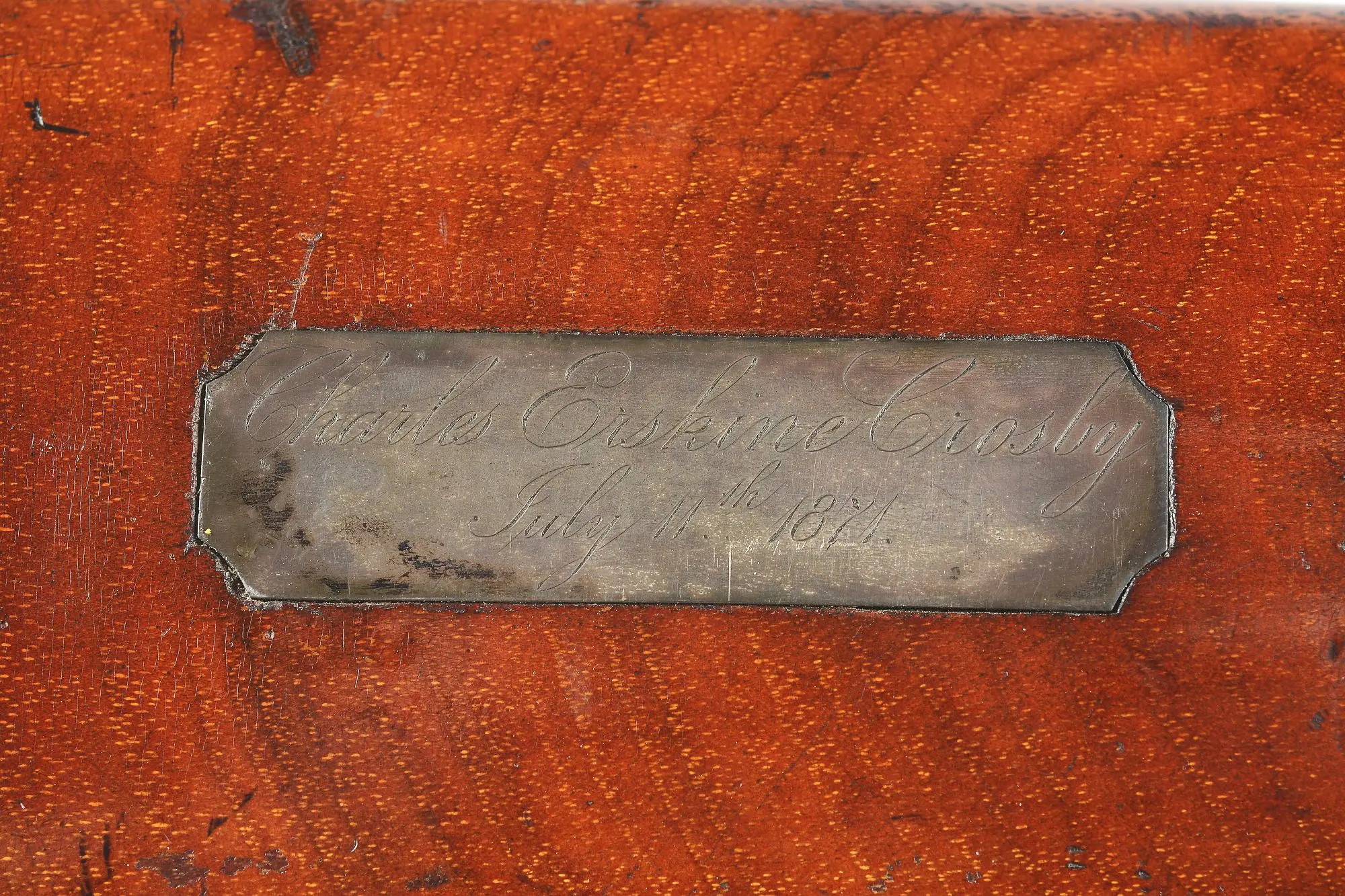
The plaque on the rifle which reads: Charles Erskine Crosby July 11th 1871

Charles Erskine Crosby was born in Norwich, Connecticut, on July 11, 1860, to Hiram Benjamin and Mary (Scott) Crosby.[1] It was the summer before the outbreak of the American Civil War.
Shortly after Charles turned two, his father Hiram paused his legal career and enlisted in the Union Army where he rose to the rank of Colonel in the 21st Connecticut Regiment Infantry. Hiram served for two years after which he resumed his law practice as well as engaged in several new business ventures. This involved more time away from Norwich and family.
Hiram’s ambitions drew him to New York City. So in about 1869,[2] Hiram, his wife Mary, and Charles moved into Mary’s parents’ home in North Salem in the northeast corner of Westchester County, New York. This became the permanent home for Charles and his mother,[3] but I suspect that his father did not spend much time there. His law office was about 50 miles away in Nassau Street in the Financial District of Manhattan—too far for a daily commute—and he travelled a lot for his work. Plus, and probably unbeknownst to Mary and Charles for many years, Hiram had a second family who lived in Manhattan not far from Hiram’s Nassau Street law office.
Charles showed an early interest in journalism. As a 13-year-old in the summer of 1873, he published an amateur newspaper in North Salem called Charlie Crosby’s Journal.[4] There were numerous amateur papers created by American youths at that time from which came “professional journalists, editors, authors, publishers, scientists, inventors, governors, Senators, judges, ambassadors, lawyers, bankers, clergymen, educators, and men and women in almost every walk of life”.[5] As an adult, Charles would become a professional journalist.
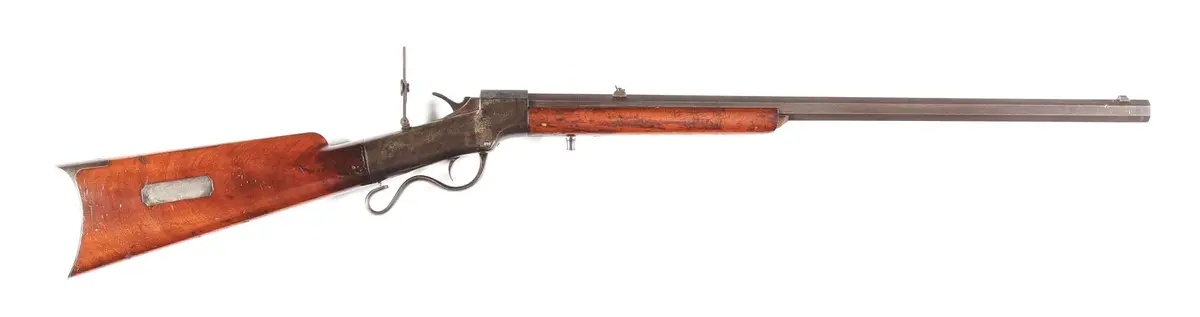
Perhaps influenced by his father’s service in the Civil War and being given a single-shot rifle for his 11th birthday (see rifle image below), Charles also developed an interest in army life. This led him overseas where he became a lieutenant in the French Army—an interesting choice.
While still in the French Army, he married French woman Anna Marguarite de Patras at St. Martin in the Fields, Westminster, England on January 26, 1882. On his marriage certificate he gave his father’s occupation as “Colonel of the Staff of the American Army”,[6] not lawyer, even though the Civil War was long finished and his father had resumed his legal career and was no longer in the Army.
After serving in the French Army, Charles and his wife moved to the U.S. and lived in New Jersey and New York.[7] In 1897, Charles was hired by the publisher of the Chicago Record and Daily News to go to Cuba to cover Cuba's fight for independence from Spain.[8] This insurrection immediately preceded the Spanish-American War.
In New York City, Charles was issued with a U.S. passport on January 20, 1897, and he immediately sailed for Havana. His passport application describes him as 5’ 3 ½” tall with blue eyes and brown hair. His complexion was light and he had a round face, high forehead, aquiline nose, medium mouth, and prominent chin.[9]
Once in Cuba, Charles eventually joined up with Maximo Gomez's insurgent forces in the interior and sent back several dispatches but used the penname “Don Carlos” in an attempt to evade Spanish authorities. Some of his work, however, fell into enemy hands. The Spanish had put a price on his head and were actively searching for him when he was killed on March 9th while watching a skirmish between the Cubans and Spaniards at Arroyo Blanco.[10] He was 36 years old, and left behind two sons under 2 and a grieving wife who was pregnant with their third son.
A newspaper account of his death was given as follows:
[A] keen eyed Spanish marksman appeared to note the position of a body of mounted officers on the verge of the forest. This consisted of Gen. Gomez, part of his staff, and Capt. Crosby. At any rate, three bullets in rapid succession plunged into the group. The first struck Crosby just below the eye and ranged upward, coming out at the back of the head. He clutched at his throat and fell forward, his spy glasses dropping from his hand.
A bugler close by sprang from his horse and caught him just as another bullet cut through his saddle. The bugler would have lost a leg if he had been a moment later. He eased Capt. Crosby's body to the ground, but the latter was already dead.
A second later a third bullet killed Gen. Gomez's horse. The old warrior sprang like a boy from the saddle as it fell. The group then hastily withdrew, carrying Capt. Crosby's body with them. It was interred with military honors.[11]
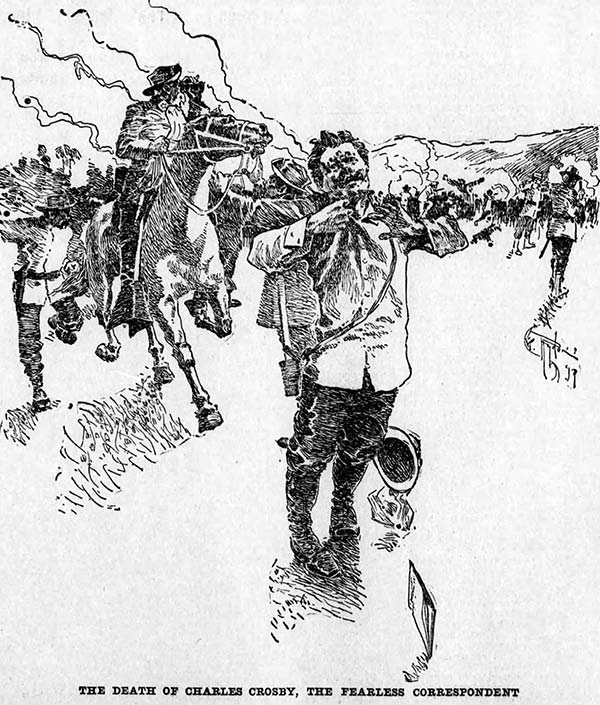
Illustration which accompanied the above account of the death of Charles Crosby
An American who had become acquainted with Charles in Havana before Charles set off to join the Cuban forces, described him as being "an energetic and fearless man, very sociable and a scholar.[12]
In December 1897, Rafael Madrigal, the US Consul to Columbia, was tasked with going to Cuba "to relieve a woman's distress—to obtain from Gomez for the widow of Charles Crosby his money and personal belongings” which despite the war still raging, Madrigal was able to do.[13] The belongings, including Charles’ gold ring which Charles’ widow, Anna, was particularly anxious to obtain, were handed over to Fitzhugh Lee, the U.S. Consul General in Havana, who forwarded them to Anna.[14]
As per his mother’s Will, a monument was erected in Maple Shade Cemetery, Ridgefield, Connecticut (which is near North Salem, NY) for her son Charles, her parents and herself.[15]
Father: Hiram Benjamin Crosby (1831-1900)
Mother: Mary Zilpha Scott (ca 1842-1903)
Spouse: Anna Marguarite de Patras (1861-1937)
This rifle was auctioned online at morphyauctions.com. The auction closed on Wednesday, November 18, 2020. The final price was $615. The description of the rifle was:
Ballard style single shot rifle made by Merrimack Arms and Manufacturing Company, Newburyport, Massachusetts from 1867 to 1869. Blued octagon barrel with blade front sight and rear flip sight barrel marked with "No. 32" and matching serial number to frame. Case hardened action with tang sight and plain trigger. Walnut plain stock with case hardened steel buttplate. Coin silver plaque with "Charles Erskine Crosby July 11th 1871" on right side of stock. Plain walnut forearm with pewter nosepiece and slide shell extractor. CONDITION: Blue fading to a plum color. Case colors fading to a silvery patina. 20% original varnish with light usage dings and marks. Small chip missing on comb and missing nosepiece. Good bore and mechanics. DLM Barrel Length: 24" Caliber/Bore: .32 FFL Status: Antique Manufacturer: Merrimack Arms Model: Ballard Serial Number: 19020.
The plaque on the rifle which reads: Charles Erskine Crosby July 11th 1871
Published 9 April 2026. Last updated 10 April 2026.
| 1 | Home page |
| 2 | What's new |
| 9 | Feedback form |
| 0 | Access key details |