
1913 - Off to College
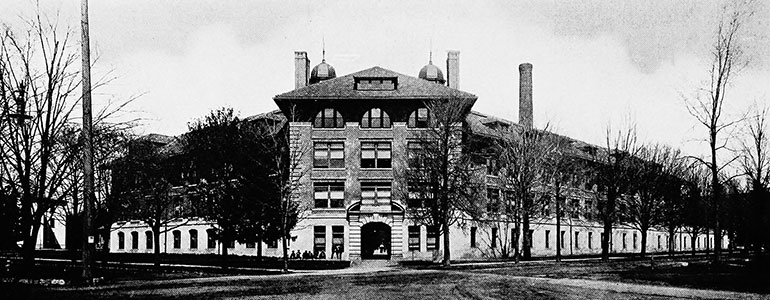
Department of Engineering Building, University of Michigan, Ann Arbor, Michigan
The University of Michigan and the Seth Harrison Scholarship Fund
In 1895, Hiram Ely’s great-aunt, Clara Harrison Stranahan (1831-1905), gave $25,000 to the University of Michigan to establish the Seth Harrison Scholarship Fund, in memory of her father, for the benefit of his descendants[1]—of which there were many! Clara was an author, poet, and the founder of Barnard College, and at one time was called "the best educated woman in the United States". She had married US Congressman James S.T. Stranahan (1808-1898) who from his benefactions and public spirit was known as "Brooklyn's first citizen".[2]
The scholarship fund enabled and enticed many of Hiram Ely’s brothers, sisters, and cousins to attend the University of Michigan. Hiram was no exception, and so in the fall following his graduation from Rutherford High School, Hiram set off for Michigan. A few years later, he wrote about his time there:
The first of October [1913] found me at Ann Arbor, Michigan, about to commence a course in Electrical Engineering. I roomed with Leon [his brother] at Moe’s; Emily [his married sister] lived in Ann Arbor and Helen was there so I was not badly off for relatives, and friends came with the passage of time.
I was invited to visit several of the fraternity houses and finally, to join the Chi Psi which I did; they then had their lodge on Huron Street but now have a new one on State Street. I joined with a very good band of fellows, any of whom I can count as friends....Well do I remember the week of initiation ceremonies, and since I remember it and no one else need do so, I shall not make any record here.
In the faculty at the U of M I found many friends and perhaps, a few enemies for I had had a large family go before me, but I never had much trouble getting along with any of them. Professors Butts and Smeaton were old friends of Seth's [Hiram's brother] and treated me well. Dr. Adams in French and Sam Hoexter in Drawing were all right...[3]
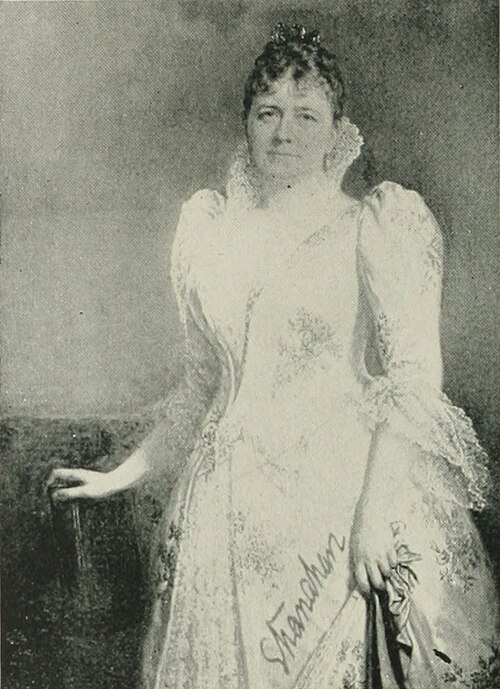
Clara Harrison Stranahan, Hi Ely's great-aunt
Hiram's youngest sister was named after her. His younger brother was named after her husband, James S.T. Stranahan.
A Little Law Case
Early in the fall I was brought to try my abilities at a little law case in which I was defendent, counselor et al. Mrs. J.S.T. Stranahan, father's aunt, had left the University a sum of money the benefit from which was to be used as a scholarship fund divided into equal shares for all of her father's descendants.
There were six of us present and the sum for each amounted to several hundred dollars a year, a sum worth having. I had no trouble in drawing my monthly portion for several months but then one bright morning President Hutchins called me up and informed me that inasmuch as I had enrolled in the Engineering Department and as Mrs. Stranahan's document of bestowal specified that the beneficiaries were to be enrolled in the Department of Literature, Science and the Arts, he was sorry but he must inform me that I was no longer to make myself a monthly visitor at the Treasurer's office.
He let me take home the University Law book on the subject and thereon I was to build a case.
There are ways and ways of interpreting and then one has only to interpret the interpretation to the satisfaction of the “interpreter”. I built my case thusly: Mrs. S. had made her grant in 1890; the Dept. of Engineering had not been created until 1894. She stated in the grant that her purpose was to aid in the obtaining an education all of Seth Harrison’s descendants; why would she not be just as desirous to aid in a good honorable Engineering education as in any other? Had this department been in existence, would she not likely have included it in her specification?
Point two: in law precedent holds great sway—one of my brothers who graduated from the E Dept in 1906 received the fund four years; another brother and a cousin received it in the Law Dept; Mrs. S. was at that time living and made no objection to their receiving the fund; therefore, said I to the Honorable President, Mrs. S, were she living today, would sanction my being a beneficiary.
The case was clear; President Hutchins saw no way around my argument. Turning to Messrs. Smith and Campbell, secretary and treasurer, respectively, of the University, the president said, “Gentlemen, would [sic] do you think of Mr. Ely's presentation of the case.”
Mr. Smith agreed with Mr. Campbell that my point seemed to hold ground. President Hutchins then turned to me and said, “Mr. Ely, your case is won. By the way Mr. Ely, you should have been a lawyer.” And I continued to present my monthly demand to the treasurer to make a noise like a check.[4]
A Change of Plans
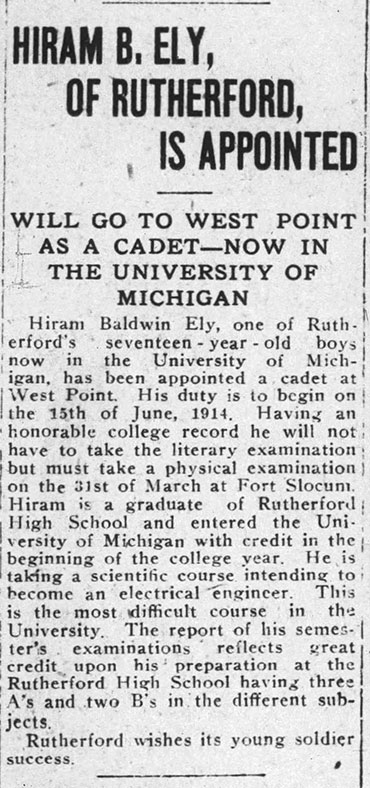
In February [1914] I received a letter from U.S. Senator William Hughes informing me that he had open an appointment to the United States Military Academy and that I might have same. For several years I had attempted (not over enthusiastically) to obtain such an appointment. Father and mother were not very anxious to have me go into the military profession but West Point seemed to be a good engineering school and the glamor had its usual effect so that I had my way and Senator Hughes' appointment was accepted.
I went to Ft. Slocum and took my physical examination the end of March—no mental examination was required—successfully passed same and was ready for entrance June 15th. I completed my first year's work at college, returning home June 1st. Three years earlier I would have scorned the idea of becoming a tin soldier; now I could scarcely wait until I should enter the service.[5]
Passaic Daily News (Passaic NJ),
February 18, 1914:
Footnotes & Sources
- [1] "The University of Michigan, an encyclopedic survey ... Wilfred B. Shaw, editor", page 1850. In the digital collection The University of Michigan, An Encyclopedic Survey. https://name.umdl.umich.edu/AAS3302.0004.001. University of Michigan Library Digital Collections. Accessed May 11, 2026.
- [2] Two sources:
- “Death of a Noted Woman”, Freeport Daily Bulletin (Freeport, Illinois), Mon, 23 Jan 1905. Newspapers.com
- A Genealogy of the Viets Family with Biographical Sketches : Dr John Viets of Simsbury, Connecticut, page 78; Ancestry.com North America, Family Histories, 1500-2000.
- [3] Hiram B. Ely, "My Autobiography", dated 31 January 1917 (pp 1-10) & 19 February 1917 (pp 10-29), pages 22-23. A 29-page handwritten document on legal-sized paper.
- [4] Hiram B. Ely, "My Autobiography", pages 23-26.
- [5] Hiram B. Ely, "My Autobiography", pages 26-27.
Published 11 May 2026